

Optimizing Green Hydrogen Production
Advanced In-Situ Gas Analysis
Green hydrogen is emerging as a cornerstone of the global shift toward sustainable energy. By splitting water into hydrogen and oxygen using electrolyzers powered by renewable energy, this process offers a pathway to carbon-neutral fuel for industrial and transportation applications.
Ensuring the efficiency, safety, and purity of hydrogen production depends on advanced monitoring and control technologies. Among these, in-situ gas analysis plays a vital role, enabling real-time measurements without compromising safety or operational integrity.
Electrolyzer Technologies: Alkaline vs PEM Systems
Hydrogen production plants rely on electrolyzers, the devices responsible for splitting water into hydrogen and oxygen. Two primary types are widely used:
- Alkaline Electrolyzers:
- Use liquid electrolytes such as potassium hydroxide (KOH).
- Well-established, durable, and lower in operational cost.
- Require careful handling to prevent contamination of hydrogen gas.
- Proton Exchange Membrane (PEM) Electrolyzers:
- Utilize a solid polymer membrane as the electrolyte.
- Offer high-purity hydrogen, compact design, and fast response to power fluctuations.
- More expensive but ideal for applications requiring ultra-pure hydrogen, like fuel cells.
Both technologies rely on high-quality electrodes, often made from nickel or platinum, to withstand harsh conditions and maintain efficient gas production. Renewable energy sources like solar, wind, or hydro power these systems, ensuring environmentally friendly hydrogen generation.
The Critical Role of In-Situ Gas Analysis
Monitoring hydrogen and oxygen levels in real time is essential for process efficiency and safety. Traditional gas analysis involves extracting samples, reducing pressure, and venting, which can compromise safety and environmental integrity, particularly in high-pressure hydrogen systems.
In-situ analyzers eliminate these risks by measuring gases directly in the process stream, enabling:
- Immediate detection of deviations
- Accurate purity verification
- Continuous monitoring of safety-critical areas
Key Monitoring Points in Hydrogen Production
To optimize hydrogen production and safety, analyzers are strategically placed at several critical locations:
- Anode Outlet: Monitors oxygen production and ensures safe oxygen management.
- Cathode Outlet: Measures hydrogen purity and quantity.
- Electrolyzer Cell Outlet: Detects gas crossover or leaks within cells.
- Gas Purification Inlet/Outlet: Verifies purification efficiency and final gas quality.
- Storage and Distribution Points: Confirms hydrogen purity before use or distribution.
- Safety Monitoring Points: Continuous surveillance to detect leaks and prevent explosive mixtures.
Advanced In-Situ Analyzer Technologies
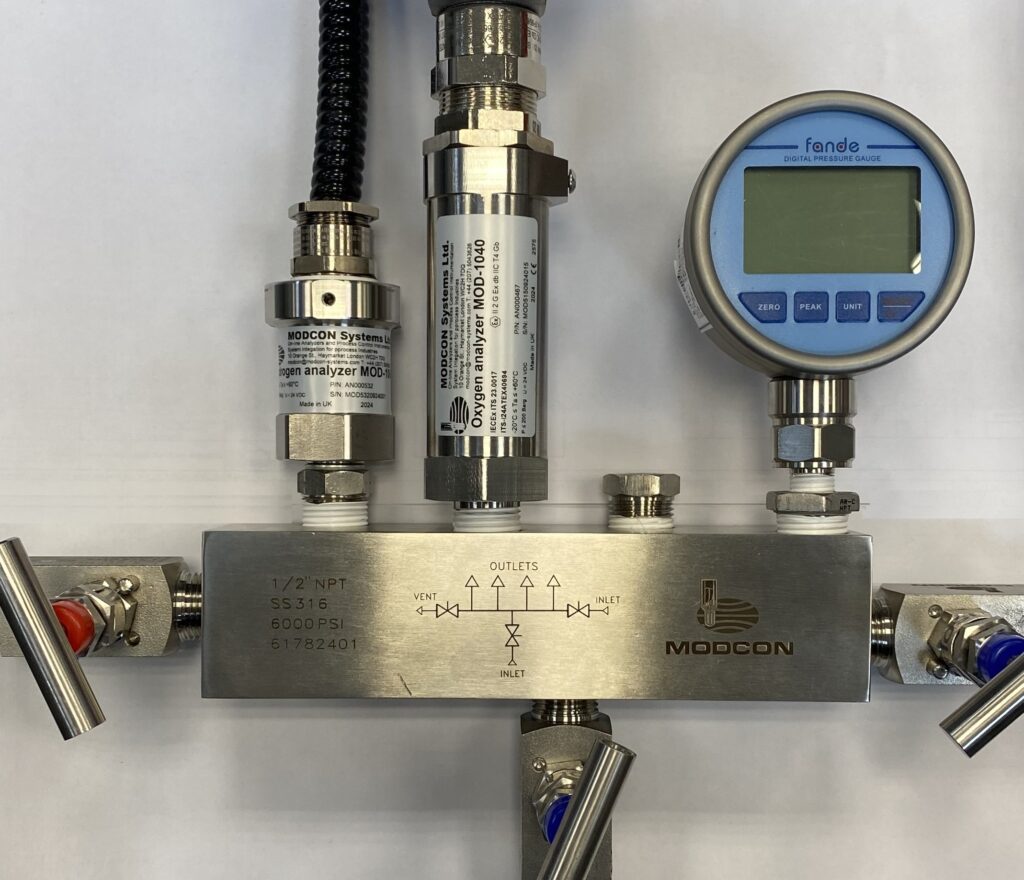
Modcon’s MOD-1040 Oxygen Analyzer and MOD-1060 Hydrogen Analyzer represent cutting-edge solutions for green hydrogen monitoring:
- MOD-1040: Uses optical sensor technology for precise oxygen measurement, even in high-moisture or KOH-containing environments.
- MOD-1060: Based on thermal conductivity, it accurately measures hydrogen and oxygen, with fast response times and minimal interference from other gases.
Modcon also offers a special sample manifold system, enabling installation of both analyzers directly in the process stream. Features include:
- Integrated pressure and temperature sensors
- On-site calibration without dismounting
- Continuous, accurate monitoring with minimal downtime
Benefits of In-Situ Gas Analysis
Implementing in-situ analysis in hydrogen production brings numerous advantages:
- Wide Measurement Range: Handles varying gas concentrations.
- Fast Response Time: Real-time monitoring for immediate corrective action.
- High Accuracy: Ensures reliable safety and product quality.
- Low Maintenance: Reduced calibration needs and operational downtime.
- Enhanced Safety: Minimizes risk of explosions and fires, supported by ATEX / IECEx / SIL2 approvals.
- Operational Efficiency: Improved process control for consistent product purity.
- Cost Savings: Simplifies system design and reduces maintenance burdens.
Conclusion
Green hydrogen production is a cornerstone of the transition to sustainable energy. By leveraging advanced electrolyzers, in-situ gas analysis, and innovative systems like Modcon’s sample manifold, operators can enhance safety, efficiency, and hydrogen purity.
As global demand for green hydrogen grows, adopting real-time monitoring technologies will be essential for reliable, scalable, and safe hydrogen production.