

Evolution in Petroleum Process Analyzers: The Rise of NIR-Based Technologies
In modern petroleum refining, margins are tight and volatility is constant. Feedstock costs can account for up to 90% of refinery cash flow, leaving little room for inefficiencies. To stay competitive, refiners must continuously optimize conversion rates, reduce energy consumption, and ensure product quality—without increasing operational costs.
This is where NIR-based petroleum process analyzers are transforming the industry. By delivering real-time, high-accuracy measurements directly in the process stream, near-infrared (NIR) spectroscopy is redefining refinery optimization.
Why Process Analyzers Are Central to Refinery Profitability
Refineries operate in a high-volume, low-margin environment. Even minor improvements in yield or energy efficiency can translate into millions in annual savings.
To achieve this, operators rely on continuous analytical feedback. Traditional laboratory testing—often aligned with standards from ASTM International—provides highly accurate results but suffers from delayed response times. In a dynamic process environment, delayed data means delayed decisions.
Online process analyzers solve this challenge by delivering:
- Continuous, real-time measurements
- Immediate detection of off-spec conditions
- Faster process adjustments
- Reduced product giveaway
The shift from periodic lab testing to continuous process monitoring has been one of the most important technological advancements in refining over the past two decades.
ASTM-Based vs. Correlative Analyzers: Finding the Balance
Historically, process analyzers in refineries have fallen into two categories:
-
ASTM-Based Analyzers
These replicate standardized laboratory procedures online.
Advantages:
- High accuracy
- Less sensitive to feedstock variability
Limitations:
- Slower response time
- High maintenance costs
- Significant capital investment
-
Correlative Analyzers (Including NIR-Based Systems)
Correlative analyzers use mathematical models to relate spectral data to physical and chemical properties.
Advantages:
- Faster analysis
- Lower maintenance
- Reduced operating costs
Challenge:
- Require calibration and validation against ASTM laboratory methods
Modern refineries must strike a balance between laboratory-grade precision and operational agility. Increasingly, NIR spectroscopy is providing that balance.
The Rise of NIR Spectroscopy in Petroleum Refining
Near-infrared spectroscopy measures molecular absorption patterns in the NIR region of the electromagnetic spectrum. These absorption signatures correlate to key hydrocarbon properties such as:
- Octane number
- Cetane index
- Aromatics content
- Density
- Distillation curves
According to the American Petroleum Institute, improving real-time monitoring directly supports compliance with fuel quality and environmental standards.
NIR analyzers offer:
- Measurement times as short as 30 seconds
- High repeatability
- Minimal consumables
- Multipoint capability
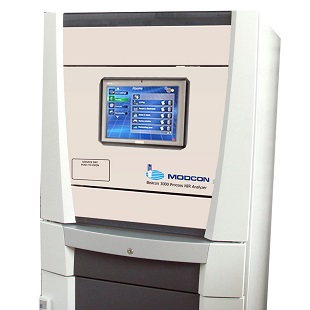
Two advanced systems leading this evolution are the Beacon 3000 and the MOD-4140.
Beacon 3000: Multiplexed, Real-Time Refinery Monitoring
The Beacon 3000 NIR Analyzer represents a significant advancement in online NIR spectroscopy.
Key Advantages
- Measures up to eight flow cells in parallel
- Rapid hydrocarbon analysis
- Seamless integration with refinery control systems
- Reduced labor and material waste
One of its most distinctive features is its architecture: the main analyzer unit is separated from field units via fiber-optic telecommunications. The field units:
- Contain no electrical components
- Have no moving parts
- Are suitable for hazardous areas
- Provide explosion-proof reliability
This design enhances both safety and installation flexibility in challenging refinery environments.
MOD-4140: Measuring Even Opaque Crude Oil
While many analyzers struggle with opaque fluids, the MOD-4140 NIR Analyzer is engineered to overcome this limitation.
What Makes It Different?
- High spectral measuring range
- Exceptional light intensity
- Ability to measure transparent and opaque hydrocarbons
- Suitable for crude oil monitoring
Crude oil contains complex heteroatomic molecules and variable compositions that can interfere with conventional optical measurements. The MOD-4140’s advanced optical design penetrates dense fluids, enabling accurate real-time hydrocarbon analysis from initial distillation through final blending.
This capability enhances:
- Feedstock flexibility
- Distillation control
- Blending optimization
- Margin improvement
Chemometrics: The Intelligence Behind NIR Analysis
NIR spectroscopy alone is not enough. The power of modern analyzers lies in chemometrics—the use of mathematical and statistical models to extract meaningful information from spectral data.
Chemometrics identifies hidden correlations between spectral patterns and physical properties. In refinery applications, this allows operators to predict:
- Product quality parameters
- Composition changes
- Process deviations
Software platforms such as Unscrambler X, SIMCA, and Minitab have historically supported these analyses. However, they require significant expertise.
Machine Learning Meets Chemometrics
The integration of machine learning (ML) into chemometric modeling is accelerating adoption.
Benefits of ML-Enhanced Modeling
- Automation: Reduced manual intervention
- Scalability: Easily handles large datasets
- Adaptability: Models evolve with process changes
- Reduced Expertise Barrier: More intuitive user experience
Modern ML-driven platforms allow users to input validated lab data, after which the software builds predictive models automatically. This reduces reliance on deep mathematical expertise while maintaining high model performance.
In refinery operations where crude variability is constant, adaptive ML-enhanced models offer significant operational resilience.
Real-Time Feedback and Process Intensification
One of the most powerful advantages of NIR-based analyzers is their ability to support process intensification.
When crude quality shifts or catalytic conditions change, NIR systems immediately reflect these variations in:
- Hydrocarbon composition
- Product quality indicators
- Blending properties
This immediate feedback enables:
- Faster control loop adjustments
- Higher production capacity
- Reduced energy consumption
- Lower environmental impact
The MOD-4140 supports advanced communication protocols, including Modbus over TCP/IP, ensuring smooth integration into distributed control systems (DCS).
The Future of NIR-Based Petroleum Process Analyzers
As refining becomes more complex and sustainability targets grow stricter, reliance on real-time analytical intelligence will increase.
NIR-based petroleum process analyzers provide:
- Faster decision-making
- Improved product consistency
- Enhanced feedstock flexibility
- Lower operational costs
- Stronger environmental compliance
Innovations like the Beacon 3000 and MOD-4140 demonstrate how optical spectroscopy, chemometrics, and machine learning are converging to create smarter, more profitable refineries.
The future of petroleum refining is data-driven—and NIR spectroscopy is leading the transformation.