

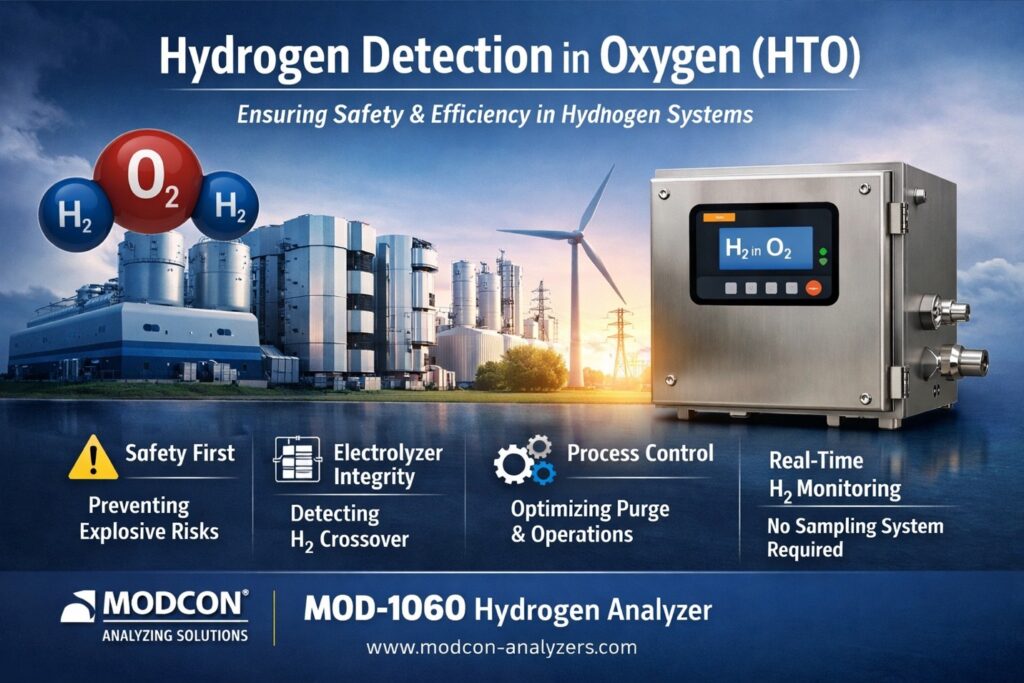
Hydrogen Detection in Oxygen in HTO Applications
Hydrogen Detection in Oxygen (HTO): A Critical Safety and Control Requirement in Modern Hydrogen Systems
As hydrogen production scales globally—driven by electrolyzers, clean energy hubs, and industrial decarbonization—hydrogen detection in oxygen (HTO) has become a non-negotiable requirement for safety, process integrity, and operational excellence.
HTO is no longer just a safety checkbox. It is a key control and diagnostic variable in modern hydrogen facilities.
What is HTO?
HTO refers to the continuous measurement of hydrogen (H₂) present in an oxygen (O₂) stream, typically at ppm to low-percentage levels, where oxygen is the dominant background gas.
This condition is most common in water electrolysis systems, where hydrogen and oxygen are produced simultaneously and strict separation is essential.
Why hydrogen in oxygen matters
Hydrogen and oxygen together form one of the most reactive and potentially hazardous gas combinations in industrial environments. Even small amounts of hydrogen in oxygen may indicate:
- Membrane degradation or failure in electrolyzers
- Gas crossover during dynamic operation
- Abnormal pressure or flow conditions
- Increased explosion and fire risk
Early, reliable detection is therefore essential—not only for protection, but for confidence in operation.
Key drivers for HTO monitoring
🔹 Safety first
HTO provides early warning well before flammability limits are approached, supporting ATEX, IECEx, and SIL-based safety architectures.
🔹 Electrolyzer protection
In alkaline and PEM electrolyzers, hydrogen crossover into oxygen headers is a known failure mode. Continuous HTO monitoring enables rapid intervention and protects stack integrity.
🔹 Process control and availability
HTO is not just an alarm—it is a process variable. Real-time insight enables controlled startups, optimized purging strategies, and higher system uptime.
🔹 Product purity and compliance
In oxygen production, storage, and downstream use, hydrogen contamination directly impacts quality, safety, and regulatory compliance.
Where HTO is applied
- Green hydrogen production (ALK & PEM electrolyzers)
- Oxygen headers and vent systems
- Hydrogen production and storage facilities
- Chemical and petrochemical plants
- Steel, metals, and energy applications
Measurement challenges in HTO
HTO applications are demanding due to:
- Large physical property differences between hydrogen and oxygen
- High-purity oxygen environments
- Dynamic operating conditions
- Safety constraints that often prohibit traditional sampling systems
These challenges are driving a clear industry shift toward robust, in-situ measurement technologies.
Installation matters more than compensation in HTO
In hydrogen detection in oxygen, accuracy depends not only on the sensing principle, but on how and where the analyzer is installed. This is especially true for TCD-based H₂-in-O₂ measurement, where many perceived “process effects” are actually installation-related.
🔹 Pressure effects: offset, not distortion
At higher operating pressures, pressure influence manifests primarily as a fixed offset, not as a dynamic error. Once calibrated at operating pressure, additional pressure compensation is generally unnecessary, provided pressure remains stable at the measurement point.
🔹 Water content: the real variable
Residual moisture in oxygen—particularly during startups, shutdowns, and load changes—can influence hydrogen readings. Managing moisture through proper installation, probe orientation, and drainage is often more effective than relying on algorithmic correction alone.
🔹 Why temperature compensation is not required
Thermal Conductivity Detection relies on relative thermal conductivity differences, making it inherently insensitive to process temperature when properly designed. As a result, explicit process temperature compensation is not required for TCD-based HTO measurement.
Installation as a success factor
Reliable HTO measurement depends heavily on correct mechanical and process integration:
- In-situ installation eliminates sampling lines where condensation, pressure drop, and dilution may occur
- Proper probe orientation prevents water accumulation on the sensing element
- Installation at a representative, well-mixed location ensures true process measurement
- Avoidance of dead legs and low points minimizes moisture-related drift
- Stable pressure at the measurement point ensures long-term repeatability
In practice, good installation delivers more accuracy and reliability than unnecessary compensation complexity.
From detection to intelligence
As the hydrogen economy matures, HTO measurement is evolving from a basic safety function into a trusted process and diagnostic signal.
For applications requiring direct, real-time hydrogen-in-oxygen measurement without sampling systems, advanced in-situ analyzers such as Modcon’s MOD-1060 are specifically designed to meet these safety and performance demands: https://modcon-analyzers.com/analyzers/mod-1060-hydrogen-analyzer/
Reliable hydrogen-in-oxygen analytics are no longer optional—they are foundational to scalable, bankable, and safe hydrogen infrastructure.